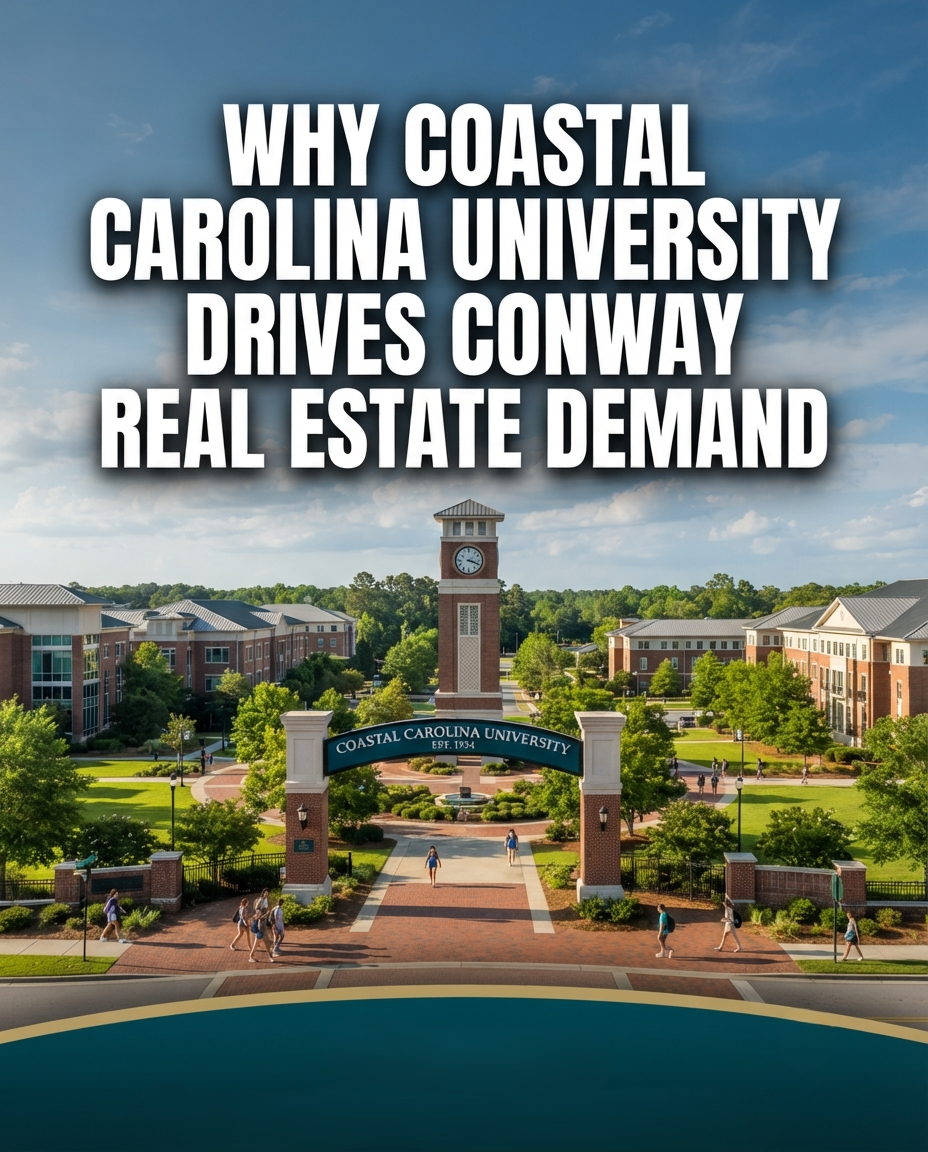
Coastal Carolina University is one of the quietest forces shaping the inland Horry County real estate market. The school sits just outside Conway, has grown steadily for two decades, and brings thousands of students, faculty, staff, and visiting families into the area every year. The downstream effects show up across the Conway housing market in ways that most casual observers miss. For buyers, investors, and even sellers, understanding the CCU impact is part of understanding why Conway has become one of the strongest small-city markets in coastal South Carolina.
Why CCU Matters to Conway Real Estate
Universities reshape the communities they sit in. CCU is no exception.
A Large, Steady Population Base
CCU brings a substantial student body to the Conway area, along with faculty, staff, and a regular flow of visiting families. That baseline population creates demand for housing, services, retail, and dining that supports steady real estate activity year-round.
Faculty and Staff as Year-Round Buyers
CCU faculty and staff are a meaningful share of the Conway home buyer pool. They tend to want proximity to campus, a real neighborhood feel, and longer-term ownership. Conway delivers all three.
Student Rental Demand
The student rental market is its own segment, with townhomes, condos, and smaller single-family homes drawing strong interest. For investors evaluating Conway, the rental income picture deserves a serious look. See our blog on the investor guide to long-term rentals on the Grand Strand for the broader investor framework.
How the CCU Effect Shows Up Across Conway
The university touches multiple Conway submarkets, not just the ones closest to campus.
Family-Oriented Subdivisions
Faculty and staff families gravitate to settled Conway subdivisions that feel like real neighborhoods. Myrtle Trace, Forest Glen, and Pecan Grove have all built steady reputations with the CCU community.
Newer Construction for Move-In Ready Demand
Buyers connected to CCU often want move-in-ready homes that do not require renovation. Newer Conway subdivisions like Fieldview and Night Owl Farms regularly produce inventory that meets that need.
Townhomes and Condos for Singles, Couples, and Investors
The CCU rental story shows up especially clearly in lower-maintenance product. Conway townhomes attract first-job graduates, working couples, and investors. For more on the product type and submarket, see our blog on a buyer's guide to townhome living in the Grand Strand area.
Why Buyers Outside the CCU Orbit Should Still Care
Even buyers with no CCU connection benefit from the CCU economic engine.
Stable Local Demand
A steady university population helps support property values through cycles. Markets with large institutional employers, including universities, tend to weather downturns better than tourist-only economies.
Year-Round Retail and Services
CCU's presence supports a deeper restaurant, retail, and services scene than Conway would otherwise have. That benefits every homeowner in the area, not just those tied to the university.
A Real-Town Feel
Universities give towns a certain character. Conway has art galleries, music venues, and a downtown energy that you do not typically find in a small inland coastal town. CCU is part of why.
What to Look at When Buying With CCU in Mind
Whether you are CCU-affiliated, a parent investing for student housing, or a long-term Conway buyer, a few specifics matter.
Proximity to Campus vs. Proximity to Downtown
CCU sits just outside Conway proper. Some buyers prioritize a quick drive to campus. Others prefer downtown Conway and a slightly longer commute. Both work, but the lifestyle is different.
Rental Rules Where Applicable
If you are buying with rental income in mind, especially around students, confirm HOA rules and lease term requirements before purchasing. Some communities limit lease length or restrict the number of unrelated occupants.
Long-Term Hold Strategy
Conway has performed well as a long-term hold market. Buyers who plan to own ten or more years tend to see the cleanest results, whether they are owner-occupants or investors. For more on the broader Conway story, see our blog on why Conway continues to attract buyers seeking small-town charm.
Key Takeaways
- Coastal Carolina University is a major economic and population engine for Conway and the surrounding inland Horry County market
- CCU drives steady demand from faculty, staff, students, and visiting families across multiple Conway submarkets
- Family-oriented subdivisions, newer construction, and townhomes and condos all see CCU-related demand
- Buyers and investors benefit from the stability a large institutional employer provides, even if they have no direct CCU connection
If Conway is on your short list, treating the CCU effect as part of the market thesis is the difference between a casual read and a serious one.
About Greg Harrelson
Greg Harrelson is a seasoned Realtor® with more than 30 years of experience serving the Myrtle Beach and Grand Strand markets. As the founder of Century 21 The Harrelson Group, Greg has built his career helping buyers, sellers, and investors achieve success in every corner of the coastal Carolina real estate market. His expertise spans residential homes, investment properties, land development, and coastal condos. Known for his deep local knowledge, innovative marketing strategies, and commitment to personal service, Greg consistently helps clients reach their real estate goals while navigating the ever-changing market with confidence and precision.