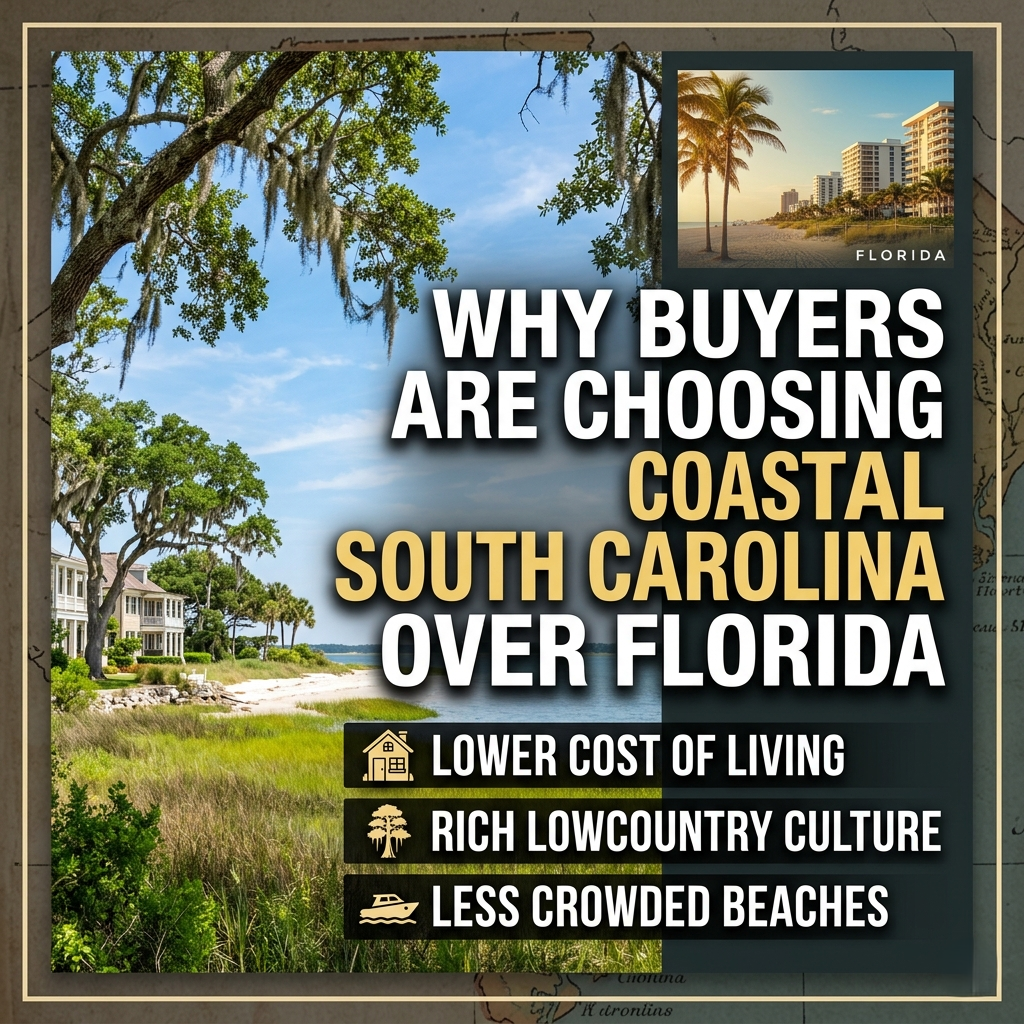
For decades, retirees and second-home buyers from the Northeast and Midwest moved to Florida almost reflexively. That pattern is shifting. Over the past several years, more out-of-state buyers have stopped at coastal South Carolina instead of continuing south. The Grand Strand in particular has emerged as a real alternative to Florida for buyers who want coastal living without some of Florida's tradeoffs. The reasons are practical, not romantic, and they show up clearly when buyers actually run the numbers.
Why Coastal South Carolina Is Pulling Buyers From Florida
The shift toward South Carolina is not about one big thing. It is about a stack of smaller advantages that add up.
Cost of Living and Cost of Ownership
Florida's coastal property markets have run up substantially over the past decade, and so has the cost of owning there. Insurance rates, HOA fees, and assessments on older buildings have climbed sharply in many Florida coastal markets. By comparison, coastal South Carolina, including the Grand Strand, still offers a meaningfully lower carrying cost for similar lifestyle profiles.
Property Taxes Favor Primary Residents
South Carolina's property tax structure treats primary residents very favorably, with a 4 percent assessment ratio and a homestead exemption for qualifying owners over 65. Florida has its own homestead protections, but for many out-of-state buyers, South Carolina's combined assessment plus exemption framework produces a competitive or better long-term tax outcome. We cover this in more detail in what makes coastal South Carolina tax-friendly for retirees.
Insurance Costs Have Become a Florida Headline
Florida's homeowners insurance market has gone through real turbulence, with carriers exiting the state, premiums rising, and some condo buildings facing assessment pressure tied to structural inspections. Coastal South Carolina has its own coastal insurance considerations, but the current pricing and availability picture is generally more favorable, particularly for inland and second-row properties. For more on the coastal insurance side, see our blog on what wind and hail insurance covers in coastal South Carolina.
What Coastal South Carolina Actually Offers
The Grand Strand is not Florida, and that is part of the appeal.
A Real Four-Season Coastal Climate
Coastal South Carolina has a milder summer climate than central or south Florida, plus a true spring and fall. Buyers who are tired of nine months of hot, humid weather often find the Grand Strand's climate more livable, especially for those who like to spend time outdoors year-round.
Beach Towns That Still Feel Like Beach Towns
Many Florida coastal markets have been built and rebuilt into dense, high-rise tourist economies. The Grand Strand has its busy stretches, but it also still has neighborhoods that feel residential, small-town beach communities like North Myrtle Beach, Cherry Grove, and the surrounding pockets that buyers say feel like coastal living should.
Access to Inland Lifestyle Options
South Carolina buyers also have the option to live inland and visit the beach, which works for many retirees and remote workers. Towns like Conway, Longs, and Loris deliver real-neighborhood living with weekend beach access. Florida's coastal markets are typically more coastal-only, with less variety in the inland mix.
What Buyers Should Think About Before Switching
South Carolina is not a strictly better choice than Florida for everyone. The honest answer depends on what the buyer values.
Climate Preferences
If you want full tropical climate and minimal winter, central or south Florida still wins. Coastal South Carolina does have real winter days, although milder than the Northeast. Snowbirds who want zero cold weather should weigh this carefully.
State Income Tax
Florida has no state income tax. South Carolina does, although the state has generous retirement income exclusions and a moderate top rate. For buyers with substantial income that is not retirement income, the difference can matter.
Existing Family and Travel Patterns
If your family base is in Florida, that ecosystem matters. If your family base is in the Mid-Atlantic, Midwest, or Northeast, the Grand Strand is generally a shorter drive home, which becomes meaningful over the long haul of retirement.
Key Takeaways
- Coastal South Carolina has become a real Florida alternative for buyers focused on cost of ownership, insurance pricing, and overall lifestyle
- South Carolina property tax treatment favors primary residents, particularly through the 4 percent assessment ratio and the homestead exemption
- The Grand Strand offers four seasons, a less tropical climate, and a mix of beach-town and inland lifestyle options
- Florida still wins on year-round warm weather and state income tax, so the comparison is real and worth running before deciding
The smart move for buyers considering a switch is to spend real time in coastal South Carolina across multiple seasons, run the carrying cost numbers honestly, and compare lifestyle fit, not just price.
About Greg Harrelson
Greg Harrelson is a seasoned Realtor® with more than 30 years of experience serving the Myrtle Beach and Grand Strand markets. As the founder of Century 21 The Harrelson Group, Greg has built his career helping buyers, sellers, and investors achieve success in every corner of the coastal Carolina real estate market. His expertise spans residential homes, investment properties, land development, and coastal condos. Known for his deep local knowledge, innovative marketing strategies, and commitment to personal service, Greg consistently helps clients reach their real estate goals while navigating the ever-changing market with confidence and precision.