Why the Condo vs. Single-Family Question Matters on the Grand Strand
On the Grand Strand, the choice between a condo and a single-family home is rarely a side-by-side comparison of equal properties. It is really a lifestyle decision, a budget decision, and an investment decision rolled into one. Buyers who get clear on what they actually want before they start touring tend to land somewhere they love. Buyers who tour widely without that clarity often end up frustrated.
A good way to get a feel for inventory is to browse both the North Myrtle Beach condos for sale page and the North Myrtle Beach homes for sale page in the same sitting. The difference in what your budget buys becomes immediately obvious.
Lifestyle Differences That Drive the Decision
Condos and the Low-Maintenance Coastal Lifestyle
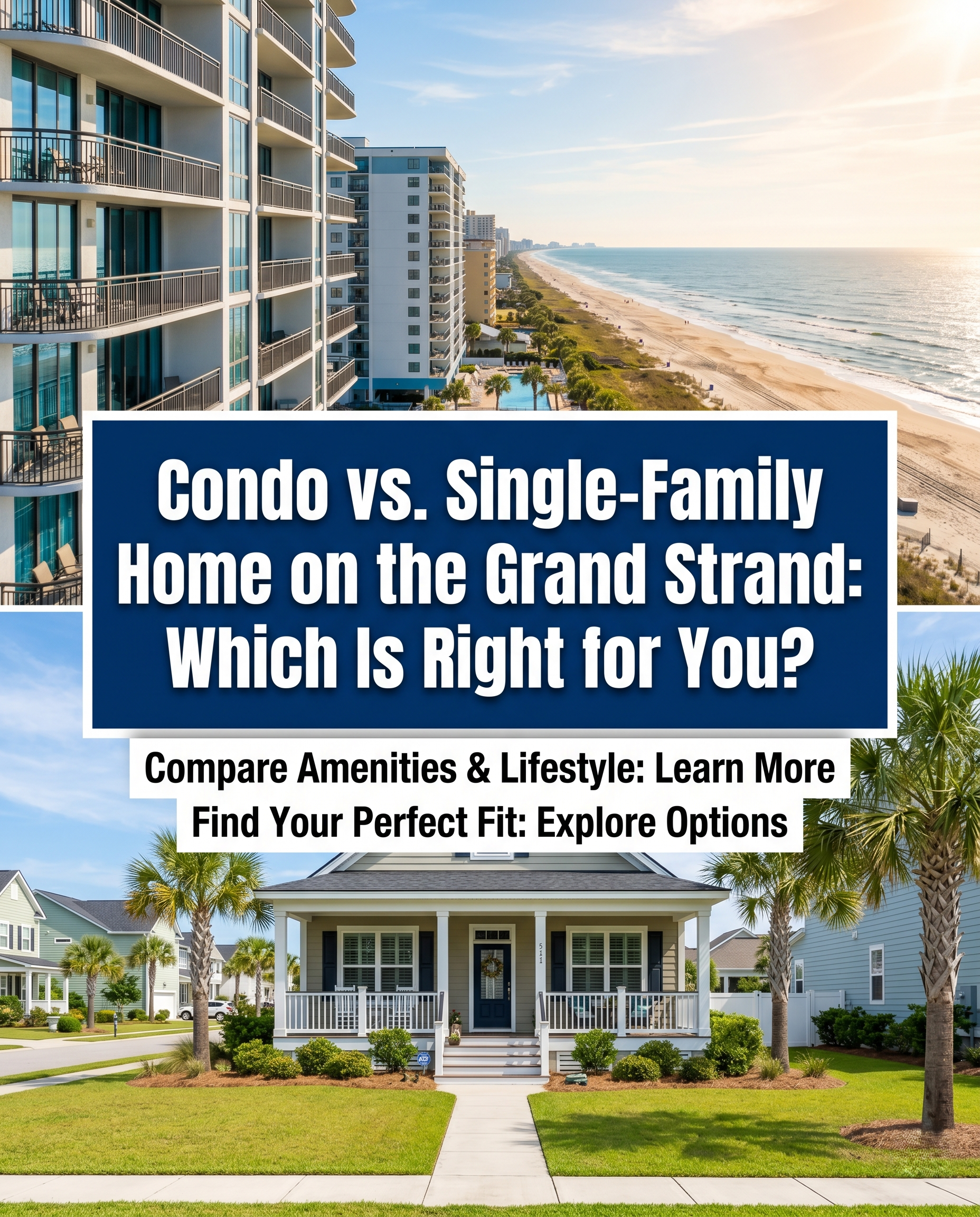
Condos appeal most to buyers who want to lock the door and leave. Exterior maintenance, landscaping, pool care, and often roof and insurance coverage run through the HOA. For second-home buyers, retirees, and anyone who wants beach access without weekend yard work, that tradeoff is exactly the point. Oceanfront and ocean-view condos in particular — the kind found across oceanfront communities in North Myrtle Beach — carry premiums for that view, but they also carry the easiest path to short-term rental income for owners interested in that.
Single-Family Homes and Space to Call Your Own
Single-family homes give buyers something a condo cannot: a yard, a garage, more storage, more privacy, and full control over the property. For families, for buyers with dogs, for boaters with trailers, and for anyone planning to live in the home full time, the single-family option usually wins on day-to-day livability. The trade is a higher entry price for an equivalent location and more personal responsibility for maintenance.
Market Conditions for Each Property Type
Condo and single-family markets on the Grand Strand do not always move in sync. Condo sales are influenced heavily by interest rates, rental income expectations, insurance costs, and HOA pressure. Single-family sales track more closely with general housing demand, employment, and migration patterns. In any given year one segment may be hotter than the other, which is why buyers benefit from looking at both before deciding.
Pricing per square foot is also misleading when comparing the two. Condos include shared amenities, building insurance, and exterior maintenance in the HOA. Single-family homes carry those costs separately. The honest comparison is total monthly cost of ownership, not list price alone.
Costs, Risks, and Practical Considerations
HOA Fees and What They Actually Cover
HOA fees vary widely across the Grand Strand. Oceanfront resort-style condos can run $700 to $1,500 a month or more, while inland villa and townhome HOAs may sit closer to $200 to $400. Before buying any condo, read the budget, reserve study, and recent meeting minutes. A low fee with a depleted reserve is more expensive than a higher fee with a fully funded one.
Insurance, Taxes, and Financing
Coastal insurance has become a serious line item. Single-family homes are typically insured fully by the owner. Condo owners carry an HO-6 policy for the interior while the master policy covers the building shell, but that division has gotten more complicated and more expensive in recent years. Financing also differs: not every lender finances every condo project, and projects with high rental ratios, pending litigation, or insufficient reserves can be tougher to finance.
Investment Potential
For buyers considering rental income, the math leans differently for each property type. Oceanfront condos in established short-term rental programs generate consistent vacation rental revenue. Single-family homes are more often used as long-term rentals or owner-occupied properties, with stronger appreciation potential and lower turnover cost. Neither is automatically better — the right answer depends on how active the owner wants to be and what return profile they are after.
Strategy for Buyers
The best-positioned buyers walk in with three answers ready. How will the property actually be used — primary residence, second home, vacation rental, long-term rental? What is the realistic total monthly cost, including HOA, taxes, insurance, and maintenance reserve? And what is the exit plan in five, ten, or twenty years? Those answers point clearly toward condo or single-family in most cases.
Working with a local agent who handles both property types regularly is essential. The questions to ask, the inspection priorities, and the negotiation points are different enough that a generalist approach leaves money on the table.
Key Takeaways
The condo vs. single-family decision on the Grand Strand comes down to lifestyle priorities, total cost of ownership, and intended use. Condos offer convenience, amenities, and vacation rental potential at the cost of HOA exposure and shared decision-making. Single-family homes deliver more space, privacy, and control with higher entry prices and full maintenance responsibility. Buyers who get specific about their goals before they tour, and who compare total monthly cost rather than list price, almost always end up in the right property.
Frequently Asked Questions
Are condos a good investment on the Grand Strand?
Condos can be solid investments, particularly in established oceanfront rental communities with strong management and predictable booking activity. The key variables are the HOA's financial health, the building's age and insurance situation, and how well the unit is set up for rentals. A well-chosen condo in a managed program can produce meaningful income, while a poorly chosen one can become a cash drain.
What does a typical Grand Strand condo HOA fee cover?
Most HOA fees cover exterior maintenance, landscaping, pool and amenity upkeep, master insurance on the building, common area utilities, pest control, and reserves for future repairs. Higher-end oceanfront buildings often also include things like elevators, on-site staff, security, cable, and trash. Always request the line-item budget before committing.
Is financing harder for condos than for single-family homes?
It can be. Lenders evaluate the entire condo project, not just the buyer, so projects with a high investor ratio, pending litigation, low reserves, or insurance gaps may not qualify for conventional or government-backed financing. Working with a local lender who already knows which buildings are approved can save weeks of back-and-forth.
Can I rent out a condo as a short-term vacation rental?
That depends entirely on the building. Some Grand Strand condos are built and zoned specifically for short-term rentals. Others have strict minimum-stay rules or prohibit rentals altogether. Always confirm the rental policy in writing before making an offer if rental income is part of your plan.
Do property taxes differ between condos and homes in Horry County?
Tax rates are similar, but assessed values and use designations matter. Owner-occupied primary residences qualify for the 4 percent assessment ratio in South Carolina, while non-owner-occupied properties (including most vacation condos and second homes) are taxed at the 6 percent ratio. That difference can be significant and should be modeled into any purchase decision.
About Greg Harrelson
Greg Harrelson is a seasoned Realtor® with more than 30 years of experience serving the Myrtle Beach and Grand Strand markets. As the founder of Century 21 The Harrelson Group, Greg has built his career helping buyers, sellers, and investors achieve success in every corner of the coastal Carolina real estate market. His expertise spans residential homes, investment properties, land development, and coastal condos. Known for his deep local knowledge, innovative marketing strategies, and commitment to personal service, Greg consistently helps clients reach their real estate goals while navigating the ever-changing market with confidence and precision.